Changing our positioning, one more time
Arc is now the open-source time-series lakehouse. Why we changed the message again, what fourteen months taught us about where telemetry ends up, and an honest look at the year from the founder side.
We are changing how we describe Arc. Again.
If you have followed us from the start, you know this is not the first time.
We started as a data lakehouse for time series. Then, as we learned what Arc was really good at, we decided to invest in that and positioned it as a time-series database. After a while that felt like it was narrowing us too much, so we went wide: a high-performance analytical database. That turned out to be too broad to mean anything to the people with the actual problem, so we came back to time series.
And now we are narrowing it one more time. From here, Arc is the open-source time-series lakehouse.
Yes, that is close to where we started. The difference is that fourteen months ago it was an idea about architecture. Today it is a description of what our users and customers are actually doing with their data, and of features that exist to support it. I have a good feeling about this one. This post is about why, and about what it feels like to change your message as a founder when you are not sure the market will agree.
What people are actually trying to do
The problem has not changed since the first line of Arc was written. Teams collect telemetry at full resolution, and full resolution is expensive to keep in hot storage. So they downsample after thirty days, delete after ninety, and hope nobody needs the detail later.
For a lot of workloads, that is fine. For some, it is not an option at all.
In aerospace, when a vehicle breaks up on re-entry, nobody wants the one-minute average of the sensor that saw it happen. You need the exact readings in the seconds before it happened, every one of them, and you may need them months later for the failure analysis.
In defense, an hourly average of border crossings tells you nothing useful. You need to know how many crossings were detected in a specific window, exactly when, and which direction each one went.
The answer is not “buy more hot storage.” Keeping years of full-resolution telemetry on fast disks costs an absurd amount of money. The data belongs in object storage, in S3 or whatever bucket you already pay for, at object storage prices, without losing a single reading.
The copy nobody wants to make
The second thing fourteen months taught us is where telemetry goes after it lands. It almost never stays in one system.
Sooner or later someone wants to join it with business data, run it through a model, or ask a question the time-series database was never built for. That work happens in Snowflake, Databricks, Trino, BigQuery. So teams build a pipeline: out of the system that stores the telemetry, into the lakehouse. Now there are two copies, a job in between that breaks on a Sunday, and two bills.
I watched this exact story years ago at InfluxData. Customers kept asking the same question: how do we get this data into BigQuery so we can do broader analysis? At the time, the honest answer was a painful export process. The question was right. The architecture made it hard.
Connecting the two worlds
What changed is not Arc’s core. It is that the pieces we have been building now line up into one answer.
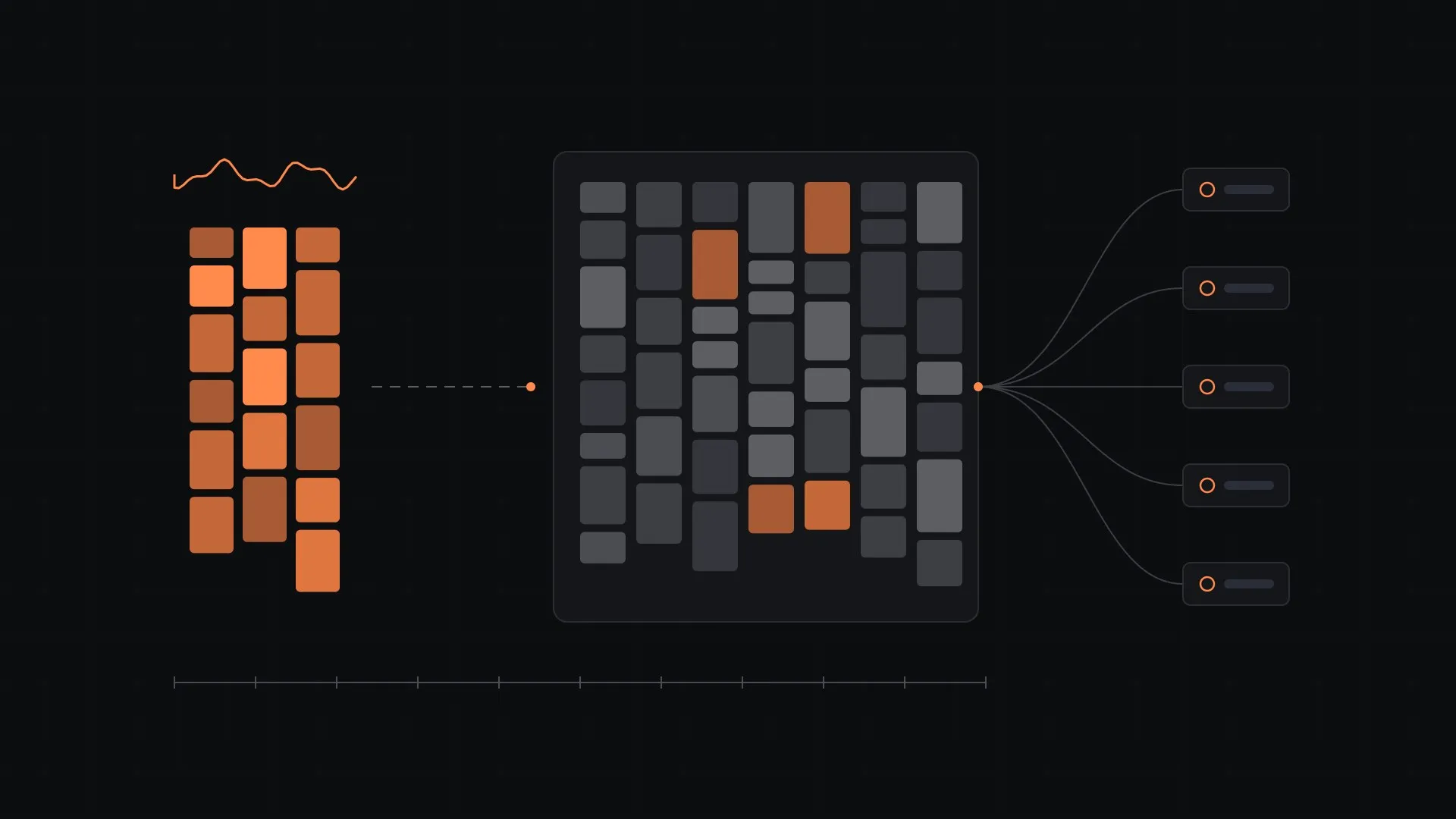
Arc has done storage tiering for a few months now. You keep, say, the last thirty days in hot storage for live dashboards and alerts, and the rest moves to cold storage in your own bucket as Parquet, at full resolution, at a fraction of the cost. One SQL query still reaches both.
In 27.01.1, our next release, Arc goes one step further: it exposes those Parquet files as Apache Iceberg tables. Same files, no copy, no export job. We have been showing it working on the Basekick Labs blog with Microsoft Fabric, Snowflake, Trino, Polars, Databricks, Spark, BigQuery, Athena, and Redshift, among others. A few to start with:
- One dataset, two engines: enabling Iceberg in Arc and querying the same Parquet files with Spark, with compaction and backup still working.
- Databricks on Arc without copying data, through AWS Glue and a Unity Catalog foreign catalog.
- Power BI on Arc without copying data, through a Microsoft Fabric OneLake shortcut.
- Power BI for time-series data, connecting Arc through Microsoft Fabric.
Or you keep using Arc’s own query layer, which runs on DuckDB today and, in the second half of 2027, on our own query engine, codename ArcX.
There is a reason this needs both halves. A lakehouse, by design, is not fast. It is built for breadth: open tables, many engines, governance, and managing data at scale. Nobody points a live dashboard that refreshes every second at an Iceberg table and expects it to keep up. A columnar time-series database is the opposite: fast on recent data, but historically a silo that everything else has to export from.
Arc mixes those two worlds. The performance of a columnar database where you need speed, and the analysis and data management of a lakehouse for everything else.
That is what “time-series lakehouse” means to us: hot telemetry fast, cold history cheap in your bucket, and the same data readable by whatever engine your analysts already use. One copy. Telemetry and analytics stop being two worlds with a pipeline between them.
Testing a message is testing a bet
From the outside, a positioning change looks like a new homepage. From the inside, it is a hypothesis about what people need, and you only find out if you are right by putting it in front of them.
It is exciting to build in the direction your users and customers are already going, and to keep going with them as their data problems get more modern. It is also, every single time, a risk. Or at least it feels like one.
Four changes of positioning in fourteen months can look, from the outside, like a company that doesn’t know what it is. From the inside, each one was a lesson: too broad, too narrow, not quite what people were buying. The product kept moving in one direction the whole time. The words took longer to catch up.
It does not matter how many people you talk to. You will never have enough signal to be certain. And the people who don’t answer are a signal too, one that is much harder to read. Underneath every one of these decisions sits a bigger question: does a small team have what it takes to keep building and thriving in a market that is more and more consolidated by big players with unlimited marketing budgets?
I don’t have a clean answer to that. I have a direction I believe in, and customers who are pulling us toward it.
The honest numbers
Basekick Labs will close this year with six figures of revenue. For a company that is fourteen months old, I think that is genuinely good, and I’m proud of it.
I’m also not going to pretend: we are not hitting the goals we set at the beginning of the year. The year is not over, and we have a few weeks of work left that I intend to use. But this repositioning, this sharper focus, makes me wonder whether it is enough to hit our targets next year. And hitting those targets means one thing: building solutions to our customers’ real problems.
Don’t read that the wrong way. We are not going anywhere. We plan to be here for a long time, growing the business and supporting the users and customers who bet on us.
Thank you
By the time you read this, it is Thanksgiving in the United States. The US is our primary market, and I’m very proud of that, and very thankful for it. Our users and customers there are remarkably open, and their feedback makes Arc better every day. So, thank you.
What comes next
There is a lot of Arc coming in 27.01.1, and a lot coming from Basekick Labs too. In an upcoming post I’ll share our roadmap and plans for 2027: here, from the founder side, and on the Basekick Labs blog, from the company and product side.
If you are keeping telemetry you can’t afford to downsample, or you are tired of the pipeline between your time-series data and your warehouse, I want to hear about it. Email me, or find us on Discord.